By: Daniel Yao Akpabli | ignewss — Xavi, Ghana
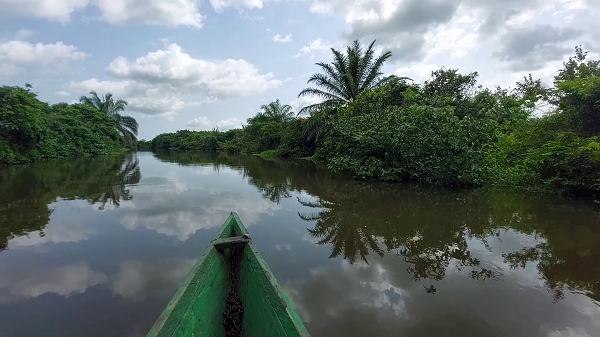
In the Volta Region, away from the bustle of Ghana’s major towns, lies Xavi, a community known for its close connection with nature and the Lotor River.
Located in the Akatsi South District, near the lower Volta coastal area, Xavi offers visitors a chance to experience the landscape through bird watching, canoeing and wildlife viewing along the Lotor (Crocodile River) and around the Avu Lagoon.
From Ho, the regional capital, the journey to Xavi leads into a quieter setting where waterways and community life meet, giving the area a distinctive character and a growing place on Ghana’s ecotourism map.
It winds through the community, past farms and homes, before giving way to a landscape where the pace of life appears to slow. Somewhere beyond the settlement is the Lotor (Crocodile River), one of the natural features around which the Akatsi South Municipal Assembly hopes to build a new economic future for the community.
For generations, the river and the surrounding environment have simply been part of life in Xavi. Now, there is a growing effort to turn that familiar landscape into an attraction for visitors while ensuring that the people who have lived alongside it remain at the heart of whatever comes next.
The ambition is considerable. The Akatsi South Municipal Assembly wants Xavi to become an ecotourism destination built around the Lotor (Crocodile River), its natural environment and the cultural heritage of the Avenor people.
But before the first visitor arrives, there is a more immediate problem to solve, the road.
The road.
Roads into Xavi do not announce the arrival of a tourist destination.
The existing access route remains one of the biggest obstacles to the development of the site.
For a destination whose appeal depends largely on bringing people into a relatively rural environment, difficult access could easily undermine the economic opportunities that tourism is expected to create.
Yes, of course, improving the road to the Lotor River must be among the immediate priorities.
Works should include opening and grading difficult sections, improving drainage, constructing or rehabilitating culverts, improving road surfaces and installing directional and tourism signs.
For the Akatsi South Assembly, however, the road is about much more than tourists. It is a route that farmers need to reach markets. It is a route through which residents connect with schools, health facilities and other essential services.
That means investment in the road could have consequences far beyond the tourism project.
And that is important in a community where tourism is being presented not as an isolated attraction, but as part of a wider attempt to expand local economic opportunities.
A river becomes an opportunity
The Lotor (Crocodile River) is central to the vision.
The river and its surrounding landscape serve as the foundation for a form of tourism that allows visitors to experience nature without destroying it.
The intention should be to create a place where people can spend time beside the river without turning the landscape into a conventional commercial entertainment centre. That distinction matters.
Ecotourism can be a delicate proposition. The very landscape that attracts visitors can be damaged by the infrastructure built to accommodate them.
Too much concrete, uncontrolled waste, poorly planned buildings or careless development could alter the character of the river and its surroundings.
Development must protect the river, vegetation, wildlife and wider ecological health of the area. Responsible construction, proper waste management, tree planting and environmental education must form part of the project.
Residents must be encouraged to take ownership of the river and help prevent pollution and indiscriminate dumping.
Plans from the Assembly include environmentally appropriate summer huts along the riverbank where visitors could sit, eat, relax or gather in small groups.
For Xavi, that may prove to be one of the most important parts of their expectation. Because the success of a tourism plan may ultimately depend not only on what is constructed but also on how the community treats the resource it already has.
Tourism that belongs to the community
There is another question that hangs over Xavi: who benefits when the visitors come?
The tourism economy could create opportunities for food vendors, farmers, artisans, transport operators, accommodation providers and other small businesses.
Young people could also be trained as professional local tour guides. That would give them an opportunity to earn an income while helping visitors understand the history, culture and natural environment of the community.
It could also change the way Xavi tells its own story.
Instead of visitors arriving, taking photographs and leaving, they could encounter people who know the land, understand its history and can explain the traditions that have shaped the Avenor area.
Local food businesses and handicraft centres are also being considered, alongside souvenir outlets and other small enterprises.
Accommodation is another potential area for private investment, with the Assembly identifying possibilities ranging from restaurants and recreational facilities to eco-lodges and event spaces.
The idea is to create an economic chain in which tourism spending circulates within the community.
A visitor who travels to Xavi would not simply pay for transport or an attraction. The same visit will support a food vendor, a farmer, a guide, an artisan and a transport operator.
That is the economic fortune a promise project for Xavi brings to the community and its adjoining villages.
Therefore, the Assembly’s usual answer to the question of “who benefits when the visitors come?” is that the people of Xavi should be among the principal beneficiaries.
More than a riverbank
The proposed development goes beyond the construction of huts beside the Lotor River.
The Assembly is considering the establishment of an office for the Xavi Eco-Tourism Project to oversee the day-to-day administration of the destination.
The office could be responsible for visitor reception, bookings, tour guides, revenue management, promotion, maintenance and data collection.
There are also plans for a tourism information and interpretation centre.
Such a facility could give visitors an opportunity to learn about the history and culture of Xavi and the environmental importance of the Lotor (Crocodile River) before exploring the area.
Nature trails and viewing platforms could provide another way of experiencing the landscape.
The plans also include security arrangements, with the Assembly saying relevant security agencies and community structures would be engaged to create a safe environment for visitors.
Taken together, the Assembly’s proposals suggest an attempt to build something more permanent than a site that people simply visit occasionally.
The ambition is to create a functioning tourism destination. But ambition alone does not build roads, toilets, reception centres or eco-lodges. The Assembly will need money.
The search for investment
For the Assembly, it intends to work with central government agencies, tourism institutions, traditional authorities, development partners, non-governmental organisations, corporate institutions and private investors.
The search for partnerships is likely to be crucial.
Potential investment areas include accommodation, restaurants, recreational facilities, transport services, eco-lodges, event facilities and souvenir centres are no jokes; however, the “can-do spirit”, the Assembly noted, will make all achievable.
The Assembly also intends to promote Xavi through television, radio, documentaries and digital platforms, as well as tourism fairs, school excursions, corporate retreats and cultural events.
The Avenor Tutudoza celebration itself offers a natural platform.
It brings together culture, history and community identity and provides an opportunity to introduce people outside Xavi to what the area has to offer.
Yet attracting visitors will require more than publicity.
People need a reason to come, they need to know that the road is accessible, that there are places to sit and eat, that sanitation is available, that the environment is safe and that there is something meaningful to experience, and they need to leave with a reason to return.
Protecting what cannot be rebuilt
For all the plans surrounding the Lotor River, perhaps the most difficult task will be protecting the very environment that makes Xavi attractive.
A river cannot simply be treated as a backdrop for tourism; its health affects the landscape, vegetation and wildlife around it.
The Assembly’s emphasis on environmental responsibility therefore sits at the centre of the entire proposal.
Waste management will matter. So will sanitation. So will the location and design of buildings, the management of visitor numbers and the behaviour of residents and tourists.
The proposed summer huts, for example, are expected to complement the landscape rather than overwhelm it, with locally appropriate materials and architectural features reflecting the cultural identity of the Avenor area.
That approach could allow the development to retain something of the character that makes the place distinctive.
The challenge will be maintaining that balance as investment grows.
A future beyond tourism
There is an argument that the most significant benefit of the project may not be the tourists themselves.
Improved roads could make it easier for farmers to move produce; better access could connect residents more efficiently to schools and health facilities; and new businesses could provide jobs.
Also, training young people as guides could create a new source of income; food vendors and artisans could find new markets.
And greater attention to the Lotor (Crocodile River) could encourage the community to protect a natural resource that has long been part of its identity.
In that sense, tourism becomes a means rather than the final destination.
Xavi is not starting from an empty canvas. The community already has its people, its culture, its landscape and its river.
What is being proposed is an attempt to connect those assets to an economy that could provide new opportunities without stripping away the character of the place.
The road ahead
For now, much of Xavi’s vision remains on paper. The road still needs attention, the visitor facilities have yet to be built, investment must be secured, management structures have to be established and the community itself must remain involved in decisions about how its natural and cultural resources are used.
The Assembly says the project will be community-centred, environmentally responsible and economically sustainable.
Those promises will ultimately be measured not by plans or speeches, but by what happens on the ground.
If the proposed investment materialises, a journey to Xavi could one day look very different.
A visitor might arrive along an improved road, park near the tourism site and walk towards the Lotor River. There could be shaded places to sit, trails through the landscape, local food to eat and guides drawn from the community to tell the story of the area.
And somewhere along the river, beneath the trees and beside the water, a visitor may begin to understand why the people of Xavi believe this place has always had something worth showing the outside world.
The challenge is to make that discovery possible without changing the very thing people came to see.
This goal, however, requires total commitment from the government, investors and the Xavi communuity.
For Xavi, the future of tourism may therefore depend on a simple equation: development without destruction, investment without exclusion and tourism that leaves something behind for the community that owns the story.
The Lotor (Crodile River) has been flowing through this landscape long before tourism became part of the conversation.
The question now is whether a new economy can grow beside it and whether, when it does, Xavi will still recognise itself.
SOURCE: www.ignewss.com