Ghana has moved to calm growing investor anxiety over the future of its mining sector, insisting that it has no blanket policy to nationalise mining assets despite rising debate over resource nationalism, local participation and the state’s handling of strategic mineral leases.
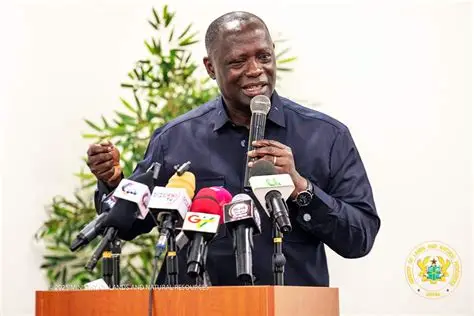
Speaking at the Ghana Chamber of Mines Breakfast Meeting in Accra on Monday, the Minister for Lands and Natural Resources, Emmanuel Armah-Kofi Buah, said the government remained committed to maintaining a predictable, transparent and rules-based mining regime capable of sustaining long-term investment.
“The government of Ghana is committed to a mining industry that continues to attract investments,” the minister said. “We are committed to an industry that is predictable, transparent and rules-based.”
The assurance comes at a sensitive moment for Ghana’s extractive industry. Recent disputes involving licensing arrangements, lease renewals, regulatory approvals and local ownership expectations have raised concerns among some investors over whether the country is shifting toward a more interventionist mining policy.
Mr Buah rejected suggestions that the administration was pursuing an ideological campaign to take over mining assets. Instead, he said individual disputes would be assessed on their own facts and within the framework of Ghana’s laws and regulations.
“The government of Ghana has not fashioned out a blanket policy of nationalising anything, but we deal with issues on a case-by-case basis,” he said.
The minister’s comments appear designed to draw a distinction between nationalisation and stricter scrutiny of mining operations. While government wants more local value from the sector, it is also seeking to reassure investors that Ghana is not abandoning the legal protections and regulatory stability that have made the country one of Africa’s leading gold producers.
That balance has become increasingly important as resource-rich African economies face renewed pressure to extract greater domestic benefits from minerals, especially at a time of elevated gold prices and rising global demand for critical minerals.
Across the continent, governments are under pressure to ensure that mining contributes more visibly to jobs, skills transfer, industrialisation, community development and domestic supply chains. But mining companies and financiers are also warning that uncertainty over tenure, licensing and fiscal terms could weaken investment appetite.
Mr Buah said Ghana’s objective was not to shut out investors, but to build partnerships that deliver stronger benefits to the country while still allowing companies to earn competitive returns.
“Our goal is to partner with investors who come to Ghana with the understanding that they are going to have a good return on their investment, but they will also leave behind expertise and help add value to our industry,” he noted.
The statement captures the emerging policy direction: Ghana wants investment, but not investment that leaves behind only exported minerals and exhausted deposits. It wants investors to contribute to a deeper mining economy built around skills, local participation, technology transfer, supplier development and value addition.
For industry players, however, the key issue will be consistency. Even where government’s intentions are framed around national interest, investors will be watching how those intentions are translated into regulatory decisions, lease reviews and enforcement actions.
The Chamber of Mines has consistently argued that regulatory stability and policy predictability remain essential to protecting Ghana’s competitiveness within Africa’s mining landscape. Mining is capital-intensive and long term, meaning companies often commit funds years before projects reach production.
Any perception that mining rights can be reopened unpredictably, or that ownership expectations may change without clear legal process, could raise the risk premium attached to Ghana’s mining sector.
Earlier at the meeting, the Chief Executive Officer of the Ghana Chamber of Mines, Dr Kenneth Ashigbey, argued that Ghana’s long-term mining growth would depend on collaborative partnerships between multinational mining firms and indigenous operators, rather than exclusionary ownership models.
That position reflects a broader industry view that local participation should be deepened through capacity-building, joint ventures, supplier development and technology transfer, not through policies that create uncertainty or weaken investor confidence.
The government’s reassurance is therefore timely. Ghana’s mining sector remains one of the country’s most important sources of export earnings, fiscal revenue and foreign exchange. But the sector also faces long-running questions about community benefits, environmental damage, local content, illegal mining and whether enough of the value generated by gold remains in the country.
Mr Buah’s comments suggest that the government is trying to reset the terms of engagement without triggering an investor confidence shock.
If Ghana can apply its mining laws transparently, review leases fairly, strengthen local participation credibly and protect investor rights, it could deepen domestic value while preserving its reputation as a stable mining jurisdiction.
But if policy signals are inconsistent, the country risks creating uncertainty at the very moment it needs capital to sustain production, expand exploration and build mining-linked industrial activity.
For now, the government’s message to investors is clear: Ghana is not pursuing blanket nationalisation.
But it is also no longer content with a mining model that delivers limited local capability, weak value addition and insufficient community transformation.
That is the new bargain being placed before the industry predictable rules for investors, but stronger domestic value for Ghana.
SOURCE: Norvanreports