By: Daniel Yao Akpabli | ignewss, HO, Ghana
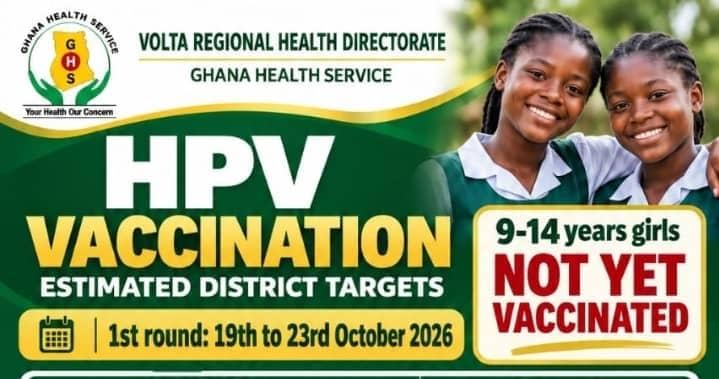
The Volta Regional Health Directorate has entered the third day of Ghana’s nationwide Human Papillomavirus (HPV) vaccination campaign, targeting girls aged nine to 14 years to protect them against HPV infections, the leading cause of cervical cancer.
The regional campaign, which began on October 19 and runs through October 23 for the first round, has an estimated target of 7,666 girls across 18 districts, according to figures released by the Volta Regional Health Directorate.
Cervical cancer remains a major public health concern, but vaccination against HPV can substantially reduce the risk of developing the disease. Health authorities are therefore urging parents, guardians, schools and communities to support the campaign and ensure that eligible girls receive the vaccine.
Volta Region sets district vaccination targets.
The Volta Regional Health Directorate has outlined targets for 18 districts, with Ho recording the highest estimated target at 800 girls, followed by South Tongu with 635 and Afadjato South with 631.
Ketu South has a target of 1,025 girls, the largest allocation in the published district figures, while Anloga is expected to reach 523 girls and Ketu North 445.
The remaining targets include Central Tongu, 426; Akatsi South, 425; Kpando, 382; Agortime-Ziope, 300; Ho West, 300; Hohoe, 300; North Tongu, 300; South Dayi, 315; Adaklu, 273; Akatsi North, 200; North Dayi, 200; and Keta, 186.
The directorate is expected to work with district health teams and community stakeholders to reach eligible girls within the campaign period.
BACKGROUND OF THE PAPILLOMAVIRUS (HPV) VACCINATION CAMPAIGN
At the national launch of the initiative somewhere in October 2025, the Minister of Health, Hon. Kwabena Mintah-Akandoh, described the campaign as a milestone in efforts to promote equitable access to healthcare, in line with the President’s vision of free primary healthcare.
He explained that although the HPV vaccine had previously been available in Ghana, its cost had limited access for some families. Under the campaign, eligible girls aged nine to 14 years can receive the vaccine free of charge.
The minister stressed that vaccination before exposure to HPV offers strong protection against infection and its associated complications. He also announced that the vaccine would become part of Ghana’s routine immunisation schedule, underscoring the government’s commitment to sustaining protection beyond the current campaign.
He called on citizens and stakeholders to support the initiative, emphasising the importance of collective action in protecting the health and future of Ghanaian girls.
Speaking on behalf of the Director-General of the Ghana Health Service, Dr Franklin Asiedu-Bekoe, Director of the Service’s Public Health Division, reaffirmed the importance of the campaign.
He said the initiative represented a commitment to every girl in Ghana that her life, health and future mattered. He further emphasised that vaccination was an important preventive intervention against a disease that could otherwise threaten the lives and aspirations of girls and women.
The campaign forms part of broader efforts to strengthen preventive healthcare, improve access to essential health interventions and reduce the burden of cervical cancer in the country.
Prof. Smile Dzisi, Deputy Director-General of the Ghana Education Service, who chaired the launch, described the campaign as a defining moment in the collective effort to safeguard the health and future of girls.
She urged parents and guardians to ensure that eligible daughters received the vaccine and encouraged the media to play an active role in public education, helping to address concerns and promote informed decisions about HPV vaccination.
The participation of the education sector is particularly important in reaching school-age girls, while collaboration with parents, community leaders and health workers can help ensure that eligible girls are not left behind.
The launch brought together representatives of civil society, faith-based groups, community organisations and other partners united by a common goal: protecting girls today to build a healthier generation tomorrow.
Also present was the Deputy Minister of Health, Prof. Dr Grace Ayensu Dankwa, who demonstrated support for the campaign by consenting to receive the vaccine as a public show of confidence in its safety.
A call to protect the next generation
As the campaign progresses, health and education authorities are encouraging parents, guardians and community leaders to support vaccination efforts and help ensure that all eligible girls have access to the intervention.
The introduction of free HPV vaccination, alongside its integration into routine immunisation, is intended to strengthen long-term protection against cervical cancer and reduce the disease burden in future generations.
For the Volta Region, achieving the vaccination target will depend on effective coordination among health workers, schools, families, community organisations and the media.
The message from health authorities is clear: protecting girls against HPV today is an important investment in their health, their future and the wellbeing of the country.
SOURCE: www.ignewss.com | Ghana Health Service