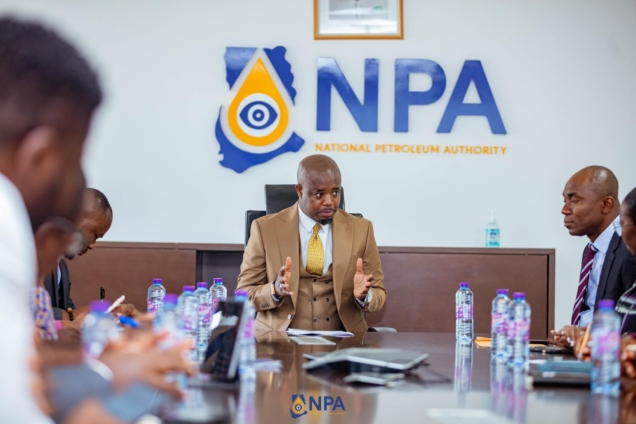
The Auditor-General has uncovered a staggering GH¢78.6 million scandal at the National Petroleum Authority (NPA), exposing widespread lapses in the regulation, monitoring and distribution of petroleum products that have potentially deprived the state of millions in tax revenue while exposing consumers to the risk of purchasing substandard fuel.
The irregularity, contained in the Performance Audit Report on the Operations of the National Petroleum Authority dated June 24, 2026, centres on the failure of the Authority to properly implement the country’s fuel marking programme, weak enforcement of petroleum transport regulations, poor monitoring of fuel distribution and questionable payments to a fuel-marking contractor.
The audit paints a troubling picture of systemic failures in the management of Ghana’s petroleum downstream sector, including the distribution of 87.3 million litres of unmarked petrol, the diversion of 9.78 million litres of petroleum products without the application of statutory penalties, payment of $2.69 million for fuel marking services on products that were never distributed, and the continued operation of thousands of unlicensed fuel transport trucks.
GH¢78.6m lost through unmarked fuel
The report found that the NPA failed to adequately carry out the marking of petroleum products under the Uniform Petroleum Pricing Fund (UPPF), leading to significant discrepancies between the volumes of fuel marked and those distributed nationwide.
According to the Auditor-General, petroleum products attracting UPPF margins worth GH¢78.6 million were distributed without first being marked.
87.3m litres question
The unmarked volumes totalled 87.3 million (87,387,400) litres of petrol, raising concerns over possible tax evasion and significant revenue losses to the state.
The report warned that because the fuel was never marked before distribution, there was no assurance that consumers received products that met the required quality standards.
“The product was of the desired quality at the pumps,” the report said, could not be guaranteed, thereby exposing motorists and other consumers to the risk of purchasing adulterated or substandard fuel from retail outlets.
Millions paid for fuel never distributed
The Auditor-General also uncovered what it described as questionable payments made to Nationwide Technologies Limited (NTL), the company responsible for providing fuel marking services.
$2.6m paid but fuel never distributed
The audit found that 638,500 litres of petrol—comprising 590,500 litres in 2023 and 48,000 litres in 2024—were marked but never distributed.
Despite the fuel never reaching consumers, NPA paid NTL a total of $2.6 million ($2,688,090) for fuel marking services.
The payments comprised $2.4 million ($2,486,010) in 2023 and $202,080 in 2024.
The Auditor-General directed the NPA to refund the entire $2.6 million into the Auditor-General’s Recovery Account No. 1018331470015 at the Bank of Ghana by December 31, 2026, and submit evidence of payment to auditors for verification.
9.7m litres diverted
The report further exposed the diversion of 9.7 million (9,781,600) litres of petrol and diesel during 2024 and 2025, in breach of the National Petroleum Authority (Bulk Road Vehicle Tracking and Volume Monitoring) Regulations, 2016 (L.I. 2251).
Under Section 20(6) of the Regulations, diverting petroleum products constitutes a criminal offence punishable by a fine of not less than 2,500 penalty units and not more than 5,000 penalty units, imprisonment of between two and five years, or both.
However, instead of applying the statutory sanctions, the NPA told auditors it merely rejected the freight claims submitted by the offending Oil Marketing Companies (OMCs).
The Auditor-General noted that by failing to enforce the penalties prescribed by law, the Authority had denied the state millions of cedis in potential revenue while weakening deterrence against fuel diversion.
Nearly 49,000 fuel deliveries went untracked
The audit also uncovered serious weaknesses in the NPA’s fuel tracking system.
Although Section 8(1) of L.I. 2251 requires the Authority to track the distribution of diesel, petrol, kerosene, premix fuel, liquefied petroleum gas, marine gas oil and other petroleum products under the UPPF scheme, auditors found that 48,678 deliveries involving Aviation Turbine Kerosene (ATK) and Naphtha were never tracked.
Management explained that the two petroleum products had been excluded because they did not attract UPPF margins.
Auditors rejected that justification, pointing out that no directive had exempted the products from tracking.
The report warned that the omission exposed the transportation and distribution of petroleum products to diversion and weakened oversight of the downstream petroleum industry.
It further noted that failure to monitor ATK was particularly worrying because aviation fuel plays a critical role in ensuring the safety of Ghana’s air transport system.
According to the report, proper tracking would also help prevent the diversion of aviation fuel for unauthorised industrial uses such as machine cleaning and degreasing.
2,390 fuel trucks operating without licences
The Auditor-General also found significant lapses in the licensing of Bulk Road Vehicles (BRVs) responsible for transporting petroleum products across the country.
As of April 9, 2026, only 2,514 out of 4,904 BRVs—representing 51.3 per cent—held valid licences to distribute petrol and diesel nationwide.
This means that almost half of the fuel transport fleet was operating without valid licences.
The Acting Director of Licensing told auditors during an exit meeting that the unlicensed vehicles had not been deactivated because they had been granted additional time to renew their permits.
According to the Director, suspending the vehicles would have disrupted fuel distribution across the country.
The Auditor-General, however, warned that allowing unauthorised vehicles to continue operating meant there was no assurance that the affected trucks met the required safety and technical standards to protect fuel quality, public safety and the environment.
Weak internal controls
The report also identified major internal control weaknesses within the UPPF Secretariat and the NPA’s Quality Assurance Directorate.
Although the Secretariat verified fuel orders submitted by Oil Marketing Companies against records in the Electronic Road Distribution Management System (ERDMS) before products were loaded, auditors found that officials failed to verify whether the quantities loaded into Bulk Road Vehicles matched the quantities actually distributed.
Similarly, the two departments failed to reconcile data relating to petroleum products that were marked against those eventually distributed.
The Auditor-General concluded that these weaknesses significantly undermined the effectiveness of the Authority’s fuel marking and monitoring system, increasing the risk of product diversion, revenue losses, regulatory failures and the circulation of unverified petroleum products in the market.
The findings represent one of the most comprehensive indictments of the National Petroleum Authority’s regulatory operations in recent years and are expected to intensify calls for stronger oversight and accountability in Ghana’s downstream petroleum sector.
SOURCE: Newscenta