By: Daniel Yao Akpabli | ignewss – Ho, Ghana
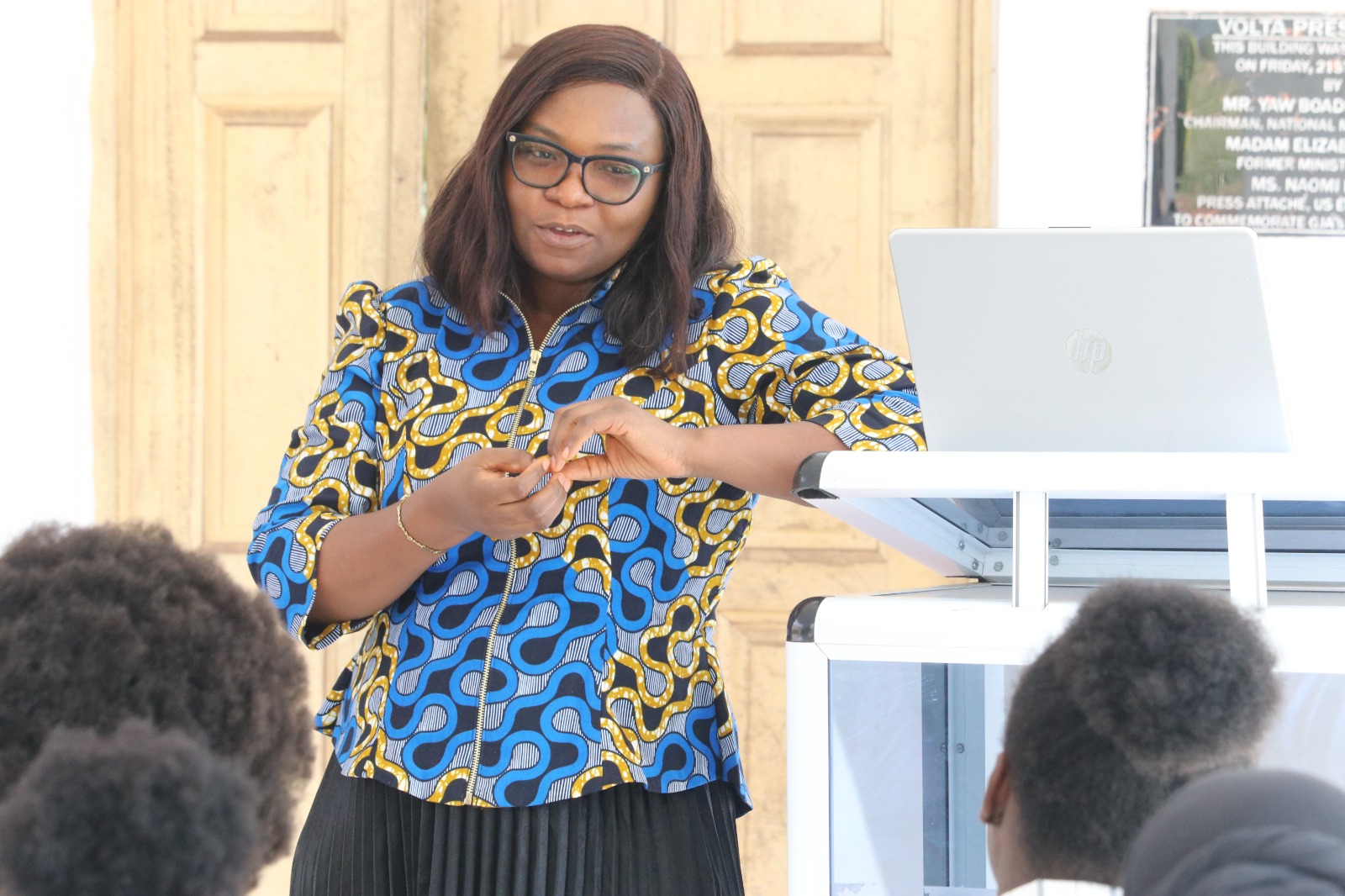
Female student journalists have been asked to move beyond press releases and official statements and develop the skills to uncover stories that show how public policies and decisions affect ordinary people.
Facilitator Jemima Achivors said journalism must go beyond reporting what officials announce to examining the real consequences of those decisions on the lives of citizens.
She was speaking at a training workshop for female student journalists at the Ghana Journalists Association (GJA) Volta Press Centre on Thursday, November 26, 2026.
Ms Achivors said young journalists must learn to identify the people behind the figures, investigate the systems affecting their lives and use different storytelling formats to make their experiences understood.
Her presentation examined digital journalism, multimedia storytelling, newsroom convergence, ethical challenges and practical ways of finding compelling stories.
The newsroom is changing
The days when journalists worked exclusively for print, radio or television are giving way to a more integrated newsroom, where a single story can be published across several platforms.
Ms Achivors explained that digital journalism offers immediacy, allowing audiences to access news as it is produced, rather than waiting for scheduled bulletins.
It also gives readers access to primary documents through hyperlinks, enabling them to examine records and evidence behind a report.
Unlike traditional broadcasting, digital platforms allow audiences to respond directly to stories through comments and other forms of interaction.
For journalists, she said, that feedback can provide leads for follow-up reporting and help newsrooms understand the issues their audiences care about, adding that the digital environment also comes with challenges.
Ms Achivors explained that online platforms use algorithms to study users’ browsing behaviour and interests, influencing the information and advertisements they are shown.
She cautioned that journalists must understand how these systems shape the news audiences encounter and how information is circulated online.
From one skill to many
The facilitator said multimedia journalism requires reporters to work with more than one storytelling format.
A multimedia story may combine text, video, audio, photographs, graphics and interactive elements to present different dimensions of the same subject.
While video can capture emotion and movement, audio gives audiences a sense of voice and tone. Infographics can make complex figures easier to understand, while text allows journalists to explore issues in greater depth.
Ms Achivors said the changing demands of the newsroom mean journalists can no longer rely on writing alone.
“You are not just a writer,” she told participants, explaining that reporters increasingly need skills in photography, video and audio editing, data analysis, graphic design and social media distribution.
She described the emerging journalist as a “backpack journalist”, one who carries a range of tools and skills to gather, produce and distribute stories.
The presentation also highlighted the evolution of multimedia storytelling, citing a 2012 New York Times report by John Branch on an avalanche in Washington that killed six skiers.
The report combined written storytelling with video and interactive three-dimensional modelling, allowing readers to explore the mountain and understand how the incident unfolded.
Ms Achivors said the work demonstrated how different formats could deepen a reader’s understanding of a story.
The pressure to publish first
As newsrooms compete for online traffic and audience attention, Ms Achivors warned that the pressure to break stories quickly can undermine accuracy.
She said journalists sometimes rush to publish without adequately checking information, particularly in an environment where clicks can translate into revenue.
But speed, she stressed, should not come at the expense of verification and accountability.
“Sometimes we don’t verify some of the errors that we make, but at the end of the day, you need to exercise accountability,” she said.
Achivors encouraged participants to read newspapers and pay attention to corrections and rejoinders, noting that responsible journalism requires media organisations to acknowledge and correct mistakes.
She said repeated errors could weaken public confidence in journalists and the institutions they represent.
The facilitator also discussed the growing use of artificial intelligence in media production, including AI-generated text, images and news presenters.
While acknowledging the changes technology is bringing, she said journalism still requires human judgement and the ability to convey emotion in telling certain stories.
Follow the impact, not just the announcement.
One of the central lessons of the presentation was the need for journalists to look beyond official statements and investigate how decisions affect people.
Ms Achivors used the scholarship allocation controversy as an example, asking participants to consider who was affected when scholarships intended for needy students were allegedly awarded to people who did not qualify.
She urged journalists to examine the consequences of policies and public decisions rather than simply reproduce statements from officials.
“Ask yourself, why should it matter? Who is being affected?” she told the participants.
She cited an investigation by The Fourth Estate into scholarship allocation, explaining how journalists used the Right to Information (RTI) process to obtain records and documents rather than waiting for an official statement.
The investigation, she said, was followed by an explainer video, social media content and radio and television interviews, adding that the approach demonstrated how journalists could use different platforms to deepen public understanding of an issue and sustain attention on its impact.
Give the story a human face
The facilitator said a strong story must be human-centered, especially when dealing with statistics that can otherwise feel distant from the lives of readers.
Using an example of a community with a large number of people living with HIV, she asked participants how they would make the figures meaningful to the public.
Her response was to “zoom in” on an individual and “zoom out” to examine the wider systems affecting that person.
According to her, the journalist could begin by telling the story of one person’s experience, including the challenges of accessing healthcare and dealing with stigma, and the report would then widen to examine the policies, laws and institutions that shape the experiences of others facing similar challenges.
Ms Achivors said this approach allows journalists to connect individual experiences to broader social issues without attempting to tell every person’s story.
She stressed the need to obtain consent, protect confidentiality and respect the privacy of vulnerable sources, particularly when reporting on sensitive health matters.
Journalism that makes a difference
The workshop challenged female student journalists to see storytelling as more than the production of news content.
Ms Achivors urged them to develop the skills to investigate, verify, explain and present stories in ways that help audiences understand the issues affecting their communities.
Her message was that compelling journalism begins with curiosity but must be sustained by evidence, ethical judgement and a willingness to follow a story beyond the first announcement.
For the young journalists, the task is not simply to report what happened but to find out why it matters, who is affected and what the evidence reveals.
In an increasingly digital and competitive media environment, Ms Achivors said journalists must learn to use new tools without losing sight of the people at the centre of their stories.
SOURCE: www.ignewss.com