By: Daniel Yao Akpabli | ignewss – ACCRA, Ghana
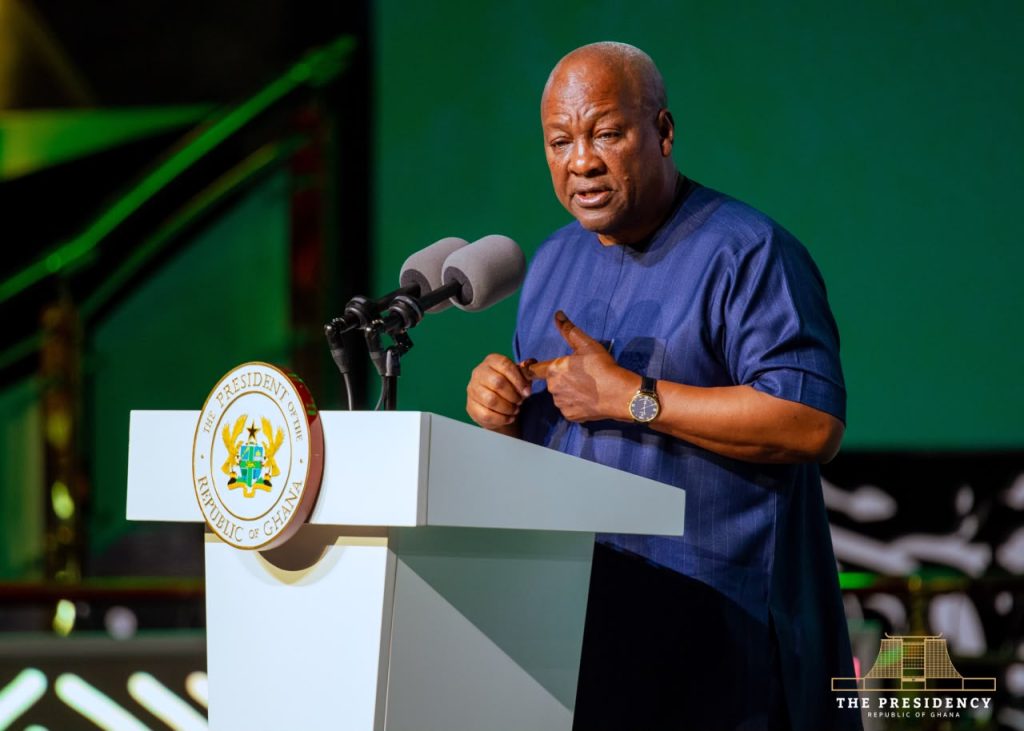
President John Dramani Mahama has announced plans to end the export of unprocessed mineral resources by 2030 as part of efforts to expand local processing, strengthen domestic industries and create jobs.
Addressing the opening of the second edition of the Mining in Motion Summit in Accra, President Mahama said Ghana would adopt a phased approach to ensure that more of its mineral wealth was processed locally before reaching international markets.
He said the policy would cover minerals including bauxite, manganese, iron and lithium, with the ultimate goal of using the country’s natural resources to support industrial development and retain more economic value within Ghana.
“We have already imposed a ban on the export of iron scrap and non-ferrous metals. I have set a clear goal that by 2030 raw minerals must no longer leave our shores,” the President said.
“Our bauxites, manganese, iron, lithium, and other minerals must support processes and industrial development here at home.”
President Mahama said the government would establish clear implementation timelines, introduce targeted legislation and set specific benchmarks for individual mineral commodities to guide the transition.
He stressed that Ghana’s mining policy must move beyond the extraction and export of raw materials towards the development of integrated industrial value chains.
Aluminium Industry a Priority
The President identified the development of an integrated aluminium industry as a key component of the government’s industrialisation agenda.
He said plans included modernising the Volta Aluminium Company (VALCO) and developing domestic aluminium refining capacity to connect Ghana’s bauxite resources to smelting and the manufacture of finished and semi-finished products.
According to him, major initiatives would require clearly defined responsibilities, measurable targets and transparent reporting to ensure that implementation could be monitored.
President Mahama acknowledged that local processing requirements alone would not be enough to transform the mining sector, stressing the need for an investment climate that supports both domestic and international businesses.
He said the government would work to provide essential infrastructure, develop technical skills and establish financing arrangements to support industrial expansion.
The President also called for predictable regulations, clearly defined institutional responsibilities and faster approval processes to give investors greater confidence.
He added that mining communities must be assured that licence conditions and environmental obligations would be enforced.
Call for Stronger African Cooperation
At the continental level, President Mahama urged African governments to take practical steps to implement the African Mining Vision, which seeks to ensure that the continent’s mineral resources contribute more directly to economic transformation.
He called for greater alignment of national mining laws and progress towards establishing the African Minerals Development Centre to promote cooperation and harmonise mineral governance across African countries.
The President also stressed the need to strengthen Ghanaian participation in the mining value chain, arguing that local businesses should move beyond providing auxiliary services to assume greater roles in ownership, management and technology development.
He identified areas such as mineral fabrication, laboratory analysis, software engineering and equipment maintenance as opportunities for Ghanaian enterprises to develop specialised capabilities and compete more effectively.
The policy direction, he said, should create opportunities for local companies to participate meaningfully in the industry while building the technical expertise required to support long-term industrial growth.
The second edition of the Mining in Motion Summit was held under the theme, “One Continent. One Voice on Minerals. Aligning Africa’s Mineral Future.”
The summit brought together policymakers, mining industry executives and African leaders to discuss the management of the continent’s mineral resources, with a focus on industrial development, investment and sustainable resource governance.
Among the dignitaries attending was Liberia’s Vice President, Jeremiah Kpan Koung Sr.
SOURCE: www.ignewss.com